Land & living28 min read
Two chickens a week
I have been running the numbers on feeding a family of four off a piece of land in southern Crete, and the arithmetic is nothing like the picture in my head.
This one started with a number I said out loud without thinking about it. Two chickens a week. That is what a family of four eats if roast chicken is a normal thing in the house, and it sounds like nothing, and then you multiply it by fifty two and you are looking at a hundred and four birds a year and a diary full of slaughter days.
I have wanted a version of this life for a long time. Land, a house built into the hill, food that comes from within sight of the kitchen. It is a dream, and I am aware it is a dream. So I decided to stop imagining it and start counting it, because I need the numbers to turn the dream into a plan.
Everything below assumes southern Crete, because that is where I would do it. Rocky ground, a long dry summer, five hundred to seven hundred millimetres of rain in a normal year and almost none of it between May and September. If you are reading this from somewhere with rain in July, some of the numbers get easier and one of them gets much easier.
Every figure here is mine, worked out on paper, rounded on purpose. Treat them as the right order of magnitude and the wrong second decimal.
Start with the calories, not the chickens
The mistake is to start with the animals, because animals are the fun part. The right place to start is the total.
annual need = 365 × (adult + adult + child + child)
            = 365 × (2,400 + 2,400 + 1,900 + 1,900)
            = 365 × 8,600
            ≈ 3,140,000 calories a year
That is the number the whole property has to hit. Everything else is a question of which crop or which animal fills which slice of it, and at what cost in land, water, feed and hours.
Once you hold three million in your head, the surprises start. The chickens I was so pleased about are a small slice. The things that actually fill the number are grain, oil and milk, and two of those three are boring.
It also gives you the two divisions that decide everything later. Calories per square metre tells you how much land you need. Calories per hour tells you how much of your life you need. Almost every argument in this article is one of those two sums, done on a different animal.
Two chickens a week
Take the original number seriously. A hundred and four birds a year, dressed at about 1.6 kg each if they are a slow growing breed and not a supermarket hybrid, is 166 kg of chicken. Split four ways that is 41 kg of chicken per person per year, which is close to double the European average for all poultry. So the first finding is that two chickens a week is generous. Worth deciding whether it is actually what you want before building the infrastructure for it.
Assume it is. You do not raise 104 birds by keeping 104 birds. You raise them in batches, because they all need the same feed at the same age and the same day of killing. Four batches of about twenty six, or two batches of about fifty two, is the practical shape.
Then you have to allow for losses. Ten to fifteen per cent between hatching and the freezer is normal, and that is with everything going right. If you hatch your own, allow seventy five to eighty per cent of set eggs actually producing a live chick. Run both backwards and the batch size falls out of the arithmetic rather than out of a guess.
eggs to set = birds wanted ÷ (hatch rate × survival rate)
            = 104 ÷ (0.78 × 0.88)
            = 104 ÷ 0.69
            ≈ 152 fertile eggs
A broody hen sits on twelve. A small incubator does forty eight. That means a breeding pen of six or eight hens and a rooster kept separately from the layers, and it means you are now in the business of genetics and not just dinner.
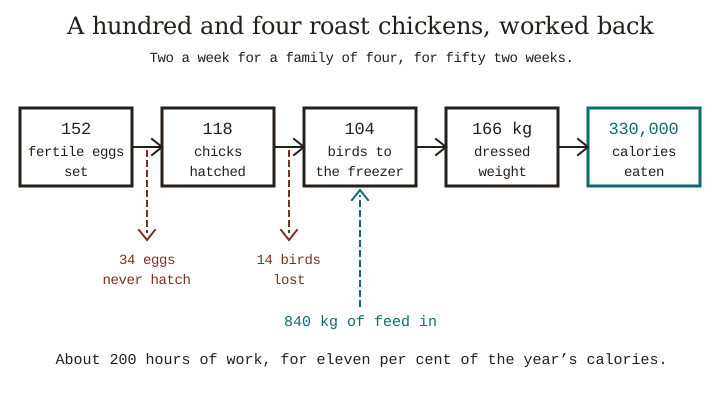
Feed is the number that kills the romance. A slow growing bird eats roughly seven kilos of feed to reach a decent size at twelve to fourteen weeks. A hundred and twenty birds is around 840 kg of feed a year. Foraging and kitchen scraps might take twenty per cent off that if the birds have real ground to work. Call it 650 to 700 kg of grain and protein you either grow or buy, for chicken alone.
And then the work. A beginner takes twenty five or thirty minutes per bird to kill, scald, pluck and clean. A practised pair with a scalder and a mechanical plucker gets to eight or ten minutes. A batch of twenty six is a five hour morning with two people, four times a year, and the first one is hard. It should be.
Eggs
Easier, and the entry point for almost everybody.
A family of four gets through fifteen to twenty eggs a week once you count baking, so call it a thousand eggs a year. A good hen lays around 250 in her first laying year, closer to 200 in her second, and less after that. On paper that is five hens.
In practice it is nine or ten. Hens moult and stop for six to eight weeks. Short winter days cut the rate hard unless you light the coop. One goes broody, one gets old, one gets taken. You keep a spread of ages and you replace about a third of the flock every year, which means raising four or five pullets annually and putting the retired hens in the stock pot, where they are better than any young bird.
Ten hens eat about 120 g of feed a day each, so 45 kg per hen per year, so 450 kg for the flock. Add that to the meat birds and you are already above a tonne of feed.
Milk and cheese
This is the one that changes your life, and not only in the good way.
In Crete you keep goats or sheep, not a cow. A good dairy goat gives two to four litres a day across a lactation of about 300 days, so 600 to 900 litres a year. A local Cretan goat gives far less, maybe 200 to 350, and is much tougher and cheaper to keep. Sheep give less milk but far richer milk, which matters in a moment.
Household demand: a litre and a half a day for drinking and yoghurt is 550 litres. Twenty kilos of hard cheese a year is another 200 litres at roughly ten litres of goat milk per kilo. Add losses and generosity and you want 800 to 900 litres a year, which is two good does or three ordinary ones.
Here is the sheep argument. Sheep milk takes about five or six litres per kilo of hard cheese against ten or twelve for goat, which is why Crete makes graviera from sheep and why the island is full of them. If cheese is the point, sheep win. If drinking milk is the point, goats win.
To have milk you must have kids or lambs every year. Three does means four or five kids a year, which means either a buck on the property or an arrangement with someone who has one, and it means deciding every spring what happens to the males. It also means milking twice a day, every day, for ten months of the year. Twenty minutes a session, three hundred days, two sessions, is two hundred hours a year that cannot be moved, rescheduled or skipped because you are tired. Dairy animals are the reason smallholders do not go on holiday.
The rest of the meat
Chicken is a lot of meat but it is thin meat. Fat and depth come from elsewhere.
One pig a year, taken to about 110 kg live, gives roughly 85 kg carcass and 60 to 65 kg of meat and fat cut and wrapped. It eats around 300 kg of feed, and it is the only animal on the property that will happily convert whey from the cheese, olive pomace, windfall fruit and everything the kitchen throws out. If you are making cheese, a pig is close to free protein. If you are not, it is an expensive one.
The goat kids and lambs you did not keep give 12 to 15 kg of carcass each, so 40 to 55 kg a year.
Rabbits are the efficiency answer nobody wants to hear. One doe produces four or five litters a year, six or seven weaned each time, and that is 40 to 60 kg of meat per doe per year, on greens, weeds and very little grain. Two does and a buck in decent hutches will outproduce the pig for a fraction of the feed and a fraction of the space. They are also the animal my kids would name, which is the whole problem with rabbits.
Between chicken, pork, goat and rabbit you are looking at 300 kg of meat a year for four people, which is more than any of us should eat and more than we could store. Which brings us to the freezer, and before that, to the reason all of this costs so much ground.
Why the trees win, in one division
Every animal on the property is a machine that takes calories in and gives fewer calories back. That is not a moral point. It is a division, and it is the same division every time.
return = calories out ÷ calories in
Feed at about 3,300 calories a kilo, and it comes out like this.
| Animal | Feed in | Food out | Calories back per 100 fed |
|---|---|---|---|
| Meat chicken | 7 kg per bird | 1.6 kg dressed | 14 |
| Laying hen | 45 kg a year | 250 eggs | 12 |
| Pig | 300 kg | 62 kg cut and wrapped | 16 |
| Rabbit | mostly greens and weeds | 50 kg per doe | high, on food you cannot eat |
| Dairy goat | grazing plus concentrate | 700 litres | high, on land you cannot crop |
| Olive tree | nothing | 4 to 8 litres of oil | there is no denominator |
Twelve to sixteen back for every hundred you put in, and the hundred you put in is grain that a person could have eaten directly. Grain to bird to plate throws away five sixths of the calories to make them taste better, which is a completely reasonable thing to want, as long as you know that is the trade you are making.
The two exceptions are the rabbit and the goat. They run on things a human cannot digest: weeds, rough grazing, the hillside you were never going to plough. Those animals add calories to the system rather than concentrating them. The tree is the outright winner because it has no denominator at all. Nothing goes in but rain and about ten days of your year.
That single division is why everything below lands where it does.
Grain, and the hectare behind the animals
Bread first. Two hundred grams of bread per person per day is 292 kg of bread a year. Bread is about sixty five per cent flour by weight, so roughly 190 kg of flour, so 240 kg of wheat at a normal extraction rate. Add pasta, pastry and the loaf you burn, and call it 300 kg of wheat a year for the humans.
Rainfed dryland wheat in this part of the world yields around two tonnes a hectare in a decent year, less in a dry one. So the land question has a formula, and you can point it at anything that eats.
land = feed needed ÷ yield per hectare
For us:
300 kg ÷ 2,000 kg/ha = 0.15 ha growing
× 2 for rotation        ≈ 0.30 ha, call it 3,000 m²
Now point the same formula at the animals. Meat birds at 840 kg, layers at 450 kg, pig at 300 kg.
1,590 kg ÷ 2,000 kg/ha = 0.80 ha growing
× 1.8 for rotation and a legume year ≈ 1.4 ha
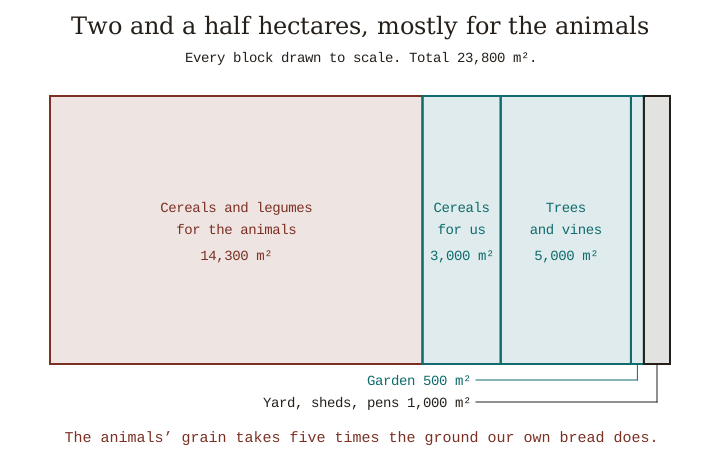
That is the central piece of arithmetic in this whole article and it took me years to accept it. The animals eat four or five times more land than the people do. A hundred and four chickens a year is not a chicken decision. It is a decision to farm a hectare and a half of grain, or to buy that hectare and a half from someone else every single year and call the result self-sufficient.
There is also the small matter of threshing and milling 300 kg of wheat by hand, which is days of work, which is why every serious version of this ends with a small mill and a relationship with the co-operative down the road.
Olives, which do the most work of anything here
Here is where Crete earns it back.
Greek olive oil consumption runs around fifteen litres per person per year, which is enormous by any other standard and completely normal here. For four people cooking properly, sixty litres a year.
A mature Koroneiki tree gives twenty to forty kilos of olives in a good year, and it takes five to six kilos of olives to make a litre of oil. Olives also alternate bearing, so you cannot plan on the good year. You plan on the pair of years.
litres = (trees × kilos per tree) ÷ 5.5

heavy year: (25 × 30) ÷ 5.5 ≈ 136 litres
light year: (25 × 10) ÷ 5.5 ≈  45 litres
two-year average ≈ 90 litres, against a need of 60
So twenty to twenty five trees give you oil in the good years and enough stored oil to carry the thin ones, with a surplus that is the single most tradeable thing on the property. Add a table olive variety and a couple of trees more for the brine barrel.
Now the calories. Oil is a shade over 8,800 calories a kilo, and a litre weighs 0.916 kg.
60 L × 0.916 kg/L × 8,840 kcal/kg ≈ 486,000 calories
486,000 ÷ 3,140,000 ≈ 16 per cent of the year
Sixteen per cent of the family’s annual energy, from twenty five trees that need no irrigation once established, no daily attention, and about ten days of work a year between pruning and harvest.
The hundred and four chickens, for comparison, are about 330,000 calories. Twenty five trees beat a year of poultry farming on calories by half again, and they do not need feeding, killing or plucking. If there is one thing this whole exercise taught me, that is it.
Vines follow the same logic. A hundred vines gives you around 150 kg of grapes, which is roughly a hundred litres of wine, and the pomace goes into the still for tsikoudia, and the leaves go into dolmades, and none of it needs summer water once the roots are down. Figs, almonds, pomegranate, carob and citrus fill the calendar. In a dry Mediterranean climate the trees are the infrastructure and the vegetable garden is the hobby.
The vegetable garden feeds you least
This is not an argument against a garden. It is an argument against believing the garden is the point.
Five hundred square metres worked well, with succession planting and a bit of protected growing, will produce six hundred kilos of vegetables a year for a family of four. Six hundred kilos of vegetables is around 150,000 calories, or 300 calories per square metre per year. That is five per cent of the annual requirement, from the part of the property that takes the most daily attention, the most water and the most heartbreak.
For scale, the same square metre under wheat returns about 340 calories, and it does not need watching. The garden is not paying you in calories at all.
What it actually delivers is everything else: vitamins, variety, the reason food tastes like anything, and the difference between eating and eating well. Add three hundred kilos of potatoes and sweet potatoes and you get another seven per cent of the calories from a crop that stores in a cool room for months.
So keep the garden. Just do not let it be the thing you plan the property around, and do not let its water demand surprise you, which it will.
Water, which is the real constraint
Household use, run carefully with low flow fittings and no lawn, is around a hundred litres per person per day. Four people is 400 litres a day, so 146 cubic metres a year.
Rainwater off a roof is the one formula on this property that never lies to you. Catchment area, times rainfall as a depth, times what you actually manage to collect.
V = area × rainfall × efficiency
  = 150 m² × 0.60 m × 0.85
  ≈ 76 m³ a year
Half your household need, in a good year. To carry the household through the five dry months on stored water:
storage = daily use × dry days
        = 0.4 m³ × 150
        = 60 m³ of cistern
That is a 60,000 litre tank, which sounds absurd until you remember that an earth sheltered house is already a hole in a hillside, and the cheapest cistern you will ever build is the one poured while the excavator is still on site.
Now the garden. Five hundred square metres under drip in July wants three to five litres per square metre per day.
500 m² × 4 L/m²/day × 120 days ≈ 240 m³
That is four to six times what the four humans in the house use, and it is more than the household’s entire annual consumption, spent in a single summer, on the five per cent of the calories.
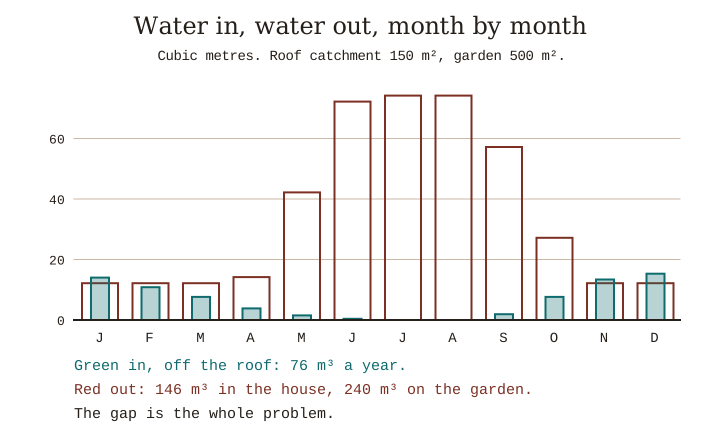
So the water arithmetic resolves in one of three ways. You have a borehole or a share in a well, and you check what it actually yields in September and not in March. Or you shrink the summer garden to something that fits your stored water and grow the bulk of your vegetables from October to May, which is what Cretan farmers have always done. Or you accept a truck delivery in August, which is what a lot of people quietly do.
Greywater from the house, maybe 200 litres a day of it, goes to the trees and covers a real fraction of the deficit. Trees are also the only part of the growing operation that will forgive you a bad year.
Electricity
Crete is one of the sunniest places in Europe, which makes this the easiest section.
An installed kilowatt peak of solar returns around 1,600 kWh a year here. The problem is never the annual figure, it is December, when the same panel gives you 2.2 to 2.8 kWh a day against six in July. So you size the array on the worst month and ignore the average entirely.
array = December need ÷ (December yield per kWp × system losses)
      = 8 kWh ÷ (2.5 × 0.65)
      ≈ 5 kWp
A household like this uses eight to ten kWh a day. The freezers alone are three of them, which is the moment the chicken decision comes back around: 166 kg of chicken plus 60 kg of pork plus 50 kg of goat needs roughly 700 litres of freezer space, which is two large chest freezers, which is a panel and a chunk of battery you would not otherwise have bought. A cool cellar at fifteen degrees, which an earth sheltered house gives you for free, replaces a surprising amount of that if you cure and preserve instead of freezing.
Five to six kWp of panels and twenty to twenty five kWh of usable battery gives two or three days of autonomy in the dark month. Solar thermal covers hot water for eight or nine months, which is why every roof in Greece has a tank on it. Cooking and the little winter heating you need in a buried house come from wood.
Where the fertility comes from
Everything above takes nutrients out of the ground. Something has to put them back, and this is where the animals justify themselves properly.
Ten laying hens produce around 450 kg of manure a year. A hundred meat birds through their batches produce something close to a tonne with bedding. Three goats add another tonne. The pig contributes as well. Composted down, you are looking at two to two and a half tonnes of finished compost.
compost wanted   = 500 m² × 4 kg/m² = 2.0 tonnes
compost produced = 2.0 to 2.5 tonnes
The loop closes almost exactly, which is the most satisfying number in this entire article.
If the feed came from a sack you bought, the fertility came from the sack too, and you are running an import business with extra steps. If you grew the feed on the hectare and a half above, the loop is real. That is the difference between a smallholding and a hobby farm, and it is measured in hectares of cereal, not in intentions.
Storing it
The freezer is the lazy answer and it is a single point of failure, because it depends on the one system most likely to fail.
Curing takes two and a half to three per cent salt by weight of meat, so a whole pig cured is two kilos of salt, and once you add olives in ten per cent brine, cheese, preserving and the animals’ needs you are buying twenty five to thirty kilos of salt a year, which nobody plans for and which costs almost nothing.
Tomatoes: a family gets through 120 to 150 kg a year fresh and as passata, and a kilo of tomatoes makes roughly six hundred millilitres of passata, so that is sixty to eighty jars put up in about three days in August.
Drying is the free option in this climate. Figs, tomatoes, herbs, beans. The sun does the work and there is no electricity bill.
And then the thing that actually makes the system safe: a stored buffer of dry staples. Forty kilos of lentils and beans, a couple of hundred kilos of grain, the year’s oil, salt and sugar. Six to twelve months of stored calories on the property is worth more than any single animal, because it is the only thing that covers you when one of the systems has a bad year, which one of them will.
The numbers in one place
| Source | Amount a year | Calories | Share |
|---|---|---|---|
| Grain and bread | 300 kg wheat | 1,020,000 | 33% |
| Meat, all kinds | ~300 kg | 610,000 | 19% |
| Olive oil | 60 litres | 486,000 | 16% |
| Milk and cheese | 550 L + 20 kg | 452,000 | 14% |
| Fruit, nuts, honey, wine | mixed | 250,000 | 8% |
| Potatoes and roots | 300 kg | 231,000 | 7% |
| Vegetables | 600 kg | 150,000 | 5% |
| Eggs | 1,000 | 70,000 | 2% |
| Total | 3,269,000 | 104% |
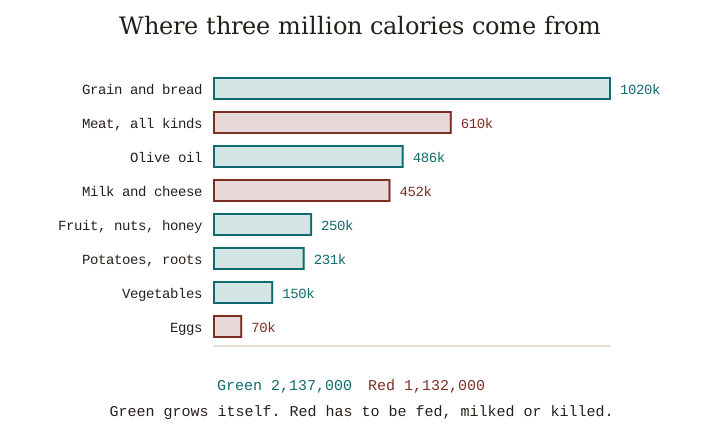
Two things fall out of that table that I did not expect when I started.
The first is that it comes to a hundred and four per cent, and it should. You do not plan a farm to hit the number exactly, because hitting it exactly means that any bad year is a hungry year. The overshoot is the margin, and in practice it leaves as gifts, trades and the surplus oil, which is the only reason a village works at all.
The second is the colour of the chart under it. Grain, oil, potatoes, vegetables, fruit and nuts are 2,137,000 calories, or two thirds of the year, and none of them need to be fed, milked or killed. The animals are the other third, and they are the reason for almost all of the land, almost all of the feed and almost all of the fixed daily hours.
Land needed: three thousand square metres of cereals for the family, a hectare and a half of cereals and legumes for the animals, half a hectare of trees and vines, five hundred square metres of garden, and the yard, sheds and pens. That comes to two and a half hectares, not the one and a half I had in my head, and the gap between those two figures is exactly the gap this article exists to close.
Two bee hives, incidentally, give twenty to forty kilos of honey and pollinate everything else, for maybe fifteen hours of work a year. Nothing else on the property pays back an hour that well, as the next section makes uncomfortably clear.
What a calorie costs in hours
Calories per square metre decides how much land you buy. Calories per hour decides whether you ever see your family. It is the second one that people work out too late.
| Calories a year | Hours a year | Calories per hour | |
|---|---|---|---|
| Our own wheat, 300 kg | 1,020,000 | 150 | 6,800 |
| Two bee hives | 91,000 | 15 | 6,100 |
| Twenty five olive trees | 486,000 | 100 | 4,900 |
| One pig a year | 150,000 | 60 | 2,500 |
| A hundred and four chickens | 330,000 | 200 | 1,650 |
| Three dairy goats | 452,000 | 300 | 1,500 |
| Five hundred square metres of garden | 150,000 | 250 | 600 |
| Ten laying hens | 70,000 | 120 | 580 |
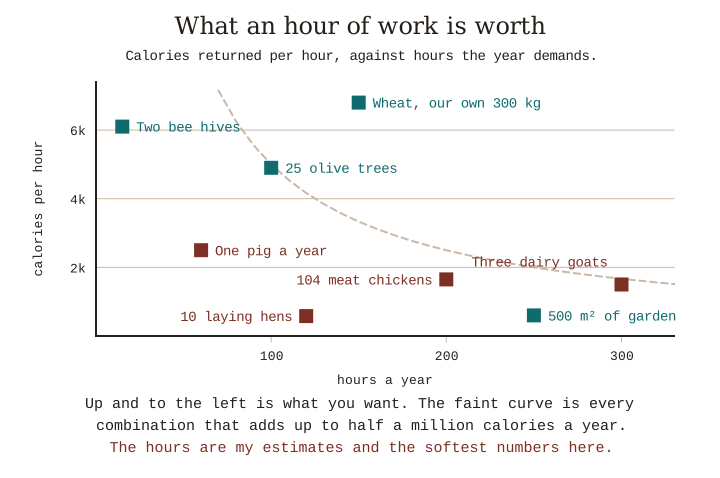
The hours are estimates and they are the softest numbers in this article, so read the ranking rather than the values. The ranking is brutal and it does not move much however you nudge the inputs.
The three things at the top are grain, bees and olives, which is to say the three things everybody happily buys from someone else. The three things at the bottom are the garden, the laying hens and the dairy goats, which is to say the three things everybody starts with, puts on the website and takes photographs of.
I do not think that means keep bees and abandon hens. It means know which of your hours are buying calories and which are buying something else, and be honest about which is which, because the hens are not paying you in food. They are paying you in a small daily ritual and eggs that taste like eggs, and those are worth hours. They are just not worth pretending about.
The labour, honestly
Twenty to thirty hours a week averaged across the year, and it does not average. February is quiet. Late May is not. Harvest weeks and slaughter days are sixty hour weeks and they arrive whether or not you have a deadline that month.
Two hundred hours of that is milking, at a fixed time, twice a day, in a fixed place. That is the constraint that decides whether the whole thing is compatible with the rest of your life, and it is the one people discover in year two rather than year zero.
A family of four is not four workers. It is one and a half adults with jobs and two children who are, for the first decade, a net labour cost. Any plan that requires both adults working the land full time is not a plan, it is a career change with a garden attached.
Whether it is cheaper
Roughly, no. Close to even, eventually, if you do not price your own time.
Running costs are six to nine hundred euros a year in bought feed at current prices, plus replacement stock, veterinary work, seed, fuel, irrigation repairs and the endless small hardware, which lands somewhere around four thousand once you stop pretending. Setup, on top of the house itself, runs somewhere between thirty five and fifty five thousand: fencing, coop and runs, a goat shed and a clean milking area, the cistern, solar and battery, freezers, a mill, an incubator, a plucker, trees and drip lines. Against that, the equivalent food quality bought in Greece is maybe eight to eleven thousand a year.
break-even = setup ÷ (food not bought − running costs)
           = 45,000 ÷ (9,500 − 4,000)
           = 45,000 ÷ 5,500
           ≈ 8 years
So it pencils out, on paper, in year eight or nine, provided nothing goes badly wrong. Now put a price on the labour and run the same division again.
45,000 ÷ (9,500 − 4,000 − 12,000) → there is no answer
Twelve hundred hours a year at even ten euros an hour is twelve thousand euros, which no smallholding of this size recovers. The denominator goes negative and the sum simply stops meaning anything. Nobody does this to save money. The return is control, quality, and the fact that a child who has plucked a chicken has a different relationship with dinner. Those returns are not financial ones; the spreadsheet does not work.
How it goes wrong
A dog gets into the run one night and you lose a year of birds in twenty minutes. Fencing is not optional and it is never as finished as you think.
Disease moves through a flock faster than you can react, and a bird flu control zone can put a stop to everything regardless of how healthy your own animals are.
One dry winter and the cistern is empty in July. Two dry winters in a row and the well drops as well, and so does everyone else’s in the valley.
One bad back in harvest week, and the entire year’s oil is on the ground.
Looking at the systems together helps me understand the risk. Say the property runs six systems that can have a bad year: the birds, the dairy, the grain, the olives, the garden and the water. Give each of them a fifteen per cent chance of failing in any given year, which is optimistic.
P(nothing fails) = 0.85 ^ 6 ≈ 0.38
P(two or more fail at once) ≈ 0.22
So a clean year happens about twice in five, and about one year in four something goes wrong twice at the same time. That is not pessimism, it is what independent risks do when you stack six of them. Redundancy is not a nice-to-have on a property like this. It is the only thing standing between a difficult year and a serious one.
And the quiet one: you build a system that requires you to be there every day, then discover that being required somewhere every day is not the same as being free. That is the failure mode I think about most, because it looks like success right up until it does not.
The mitigation for all of it is the same and it is boring. Never let one system be the only source of a category of calories. Keep the stored buffer. Keep the trees, because trees survive years that animals and gardens do not.
The eighty per cent version
Full self-sufficiency is a trap. The last twenty per cent costs more than the first eighty, and it is the part where you are hand threshing wheat and making your own salt while a perfectly good co-operative sells both down the road.
The version that actually works looks like this. Twenty five olive trees for oil. A hundred vines. Fifteen fruit and nut trees across the calendar. Ten hens for eggs. Two hives. A winter and shoulder season vegetable garden sized to your stored water, with a smaller stubborn summer patch. Two goats or a share in a neighbour’s sheep for cheese. Rabbits if you can stomach it, a pig a year if you are making cheese anyway. Bought grain and bought feed, openly and without guilt.
That gets you most of what you actually wanted at maybe a third of the labour and a fifth of the land. And it points at the thing I keep circling back to. In a Cretan village the unit of self-sufficiency has never been the household. It is the village. Oil for cheese, eggs for fish, a hand at harvest for a hand at harvest. The families who lived this way for three thousand years were not self-sufficient individually and never tried to be. They were self-sufficient collectively, and they had a network of obligations instead of a spreadsheet.
That also answers the six-systems arithmetic above. You do not survive a bad year by owning more redundancy. You survive it by knowing enough people whose bad year is not the same as yours.
Where I actually am
Nowhere near any of this. There is a house going into a hillside somewhere in the south of the island and that is the whole of it so far. No animals, no hectare of cereals, no cistern beyond what the build needs.
But I know the numbers now, and the numbers changed what I want. I came into this thinking about chickens and I am coming out of it thinking about trees, water storage and a cool room. The olives will outproduce the poultry on calories, outlive me, and never once need me to be home by six.
The chickens can wait. The trees cannot, and here the arithmetic is unusually blunt. A tree planted this winter is producing properly in seven years. Twenty five mature trees are around ninety litres of oil a year, so every year I put off the planting is ninety litres removed from the far end, permanently, and the better part of a thousand euros of oil I will buy instead. Five years of hesitation is four hundred and fifty litres that never existed, in exchange for nothing at all.
That is probably the only practical advice in five thousand words. Plant the trees first.