AI & agents5 min read
The agentic company
A company with one or two people and a dozen narrow agents doing the repetitive work, and what I think has to stay human.
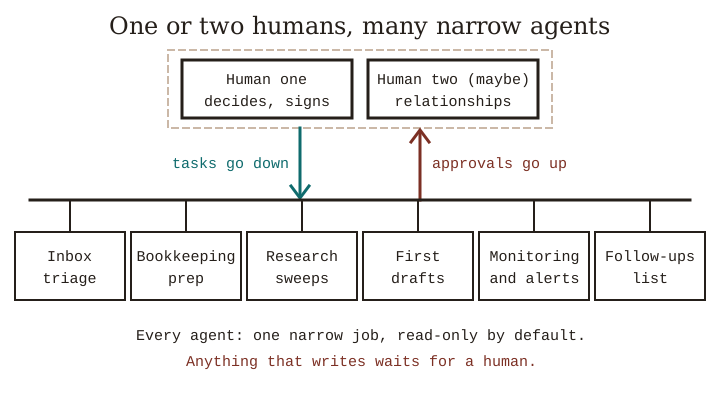
I picture one person, maybe two, at a kitchen table with a laptop, and behind them a dozen small programs that each do one boring thing well. No robot CEO, no “AI employees” with avatars, just a lot of narrow helpers and a couple of humans who decide things.
That’s what I mean by the agentic company. I’m not sure it’s a new idea, but I think it’s now cheap enough to actually try.
What the agents do
The list is not glamorous. Inbox triage: read every incoming mail, sort it into urgent, needs a reply, needs a decision, or noise, and say why. Bookkeeping prep: pull receipts and invoices into one folder, match them against bank lines, and list what didn’t match. Research sweeps: every morning, check a fixed set of sources for a fixed set of topics and write four lines about anything that changed. First drafts: a reply, a proposal, a post like this one, rough enough that I’ll fix it and good enough that I don’t start from a blank page. Monitoring: is the site up, did the backup run, did a certificate expire, did a supplier change a price. Follow-ups: who did I promise something to, who owes me an answer, how long it’s been, and whether I’ve already nudged them.
That’s the test. If I can write the job on an index card and I’d be bored doing it by Wednesday, it’s a candidate.
What stays human
Judgement, first. Should we take this client? Is this price fair? Is it time to stop? An agent can lay out the facts, but the decision stays mine, because I’m the one who has to live with it.
Relationships. I want a personal email to come from me. I’ll let an agent remind me to write to someone. I won’t let it write to them.
Deciding what the company is for. Agents optimise whatever you point them at, and if nobody is holding the “why”, you end up with a very efficient machine for doing the wrong thing.
Signing things. Contracts and payments, anything with legal weight. A human’s name goes on it and a human reads it first.
That’s a short list, and I think that’s the point: one or two people doing those four things, and a pile of software doing the rest.
Why narrow beats one big agent
The tempting version is the do-everything assistant. One agent, every tool, “just handle my stuff”. I think that turns into a mess fast. It goes off researching when you asked it to file a receipt, and when something goes wrong you can’t tell which of its twenty tools misbehaved.
A narrow agent has maybe three tools and a page of rules. I can give it a small set of examples and see whether a cheaper model can handle the job. When it breaks, there is less to inspect. When a better model comes out you swap it in for that one job and re-run the examples.
It’s the same reason a kitchen has a peeler and a bread knife instead of one blade for everything.
The boring plumbing
This part decides whether the thing is usable.
Read-only by default. Every agent starts with permission to look and none to touch. Reading mail is fine; sending it needs my yes, per message.
Approvals for anything that writes. If an agent wants to create, send, pay, delete or change, it puts the exact action in front of a human and waits.
Logs. Every run leaves a record: what it read, what it concluded, what it wanted to do, and who said yes. Boring to build, useful the day something goes sideways.
Every claim quotes its source. If the triage agent says “the accountant needs the figures by Friday”, it shows me the line from the mail that says so. If it can’t quote it, it doesn’t get to say it.
Silence when nothing happened. A monitoring agent that reports “all fine” every hour trains you to ignore it. No news, no message.
None of it is clever, and I think it’s harder to get right than the agents themselves.
How it goes wrong
Agents sound confident. A model will tell you the invoice was paid in the same tone it tells you the sky is blue. The quoting rule above is my main defence, and it’s not a complete one.
Cost creep. Six agents running every fifteen minutes, each calling a big model, adds up faster than you’d think, and it’s easy to end up with a month where the helpers cost more than the thing they were helping with. Narrow jobs on small models, running less often, fixes most of it.
The human can also become a full-time reviewer. If every agent produces something that needs approving, and you have a dozen agents, you’ve built yourself a job called “approve things”, which is arguably worse than the job you had. The fix is fewer agents and letting the read-only ones just run without asking.
Where I actually am
I’m not running a company this way. I’m running a person this way. One human, a handful of scheduled agents that sort my mail, chase my follow-ups, watch a few bills and read my notes back to me, with all the plumbing above and none of the glamour. I wrote about that setup separately.
But it’s the same shape, just smaller. Every so often I move one more boring thing over, and so far nothing has caught fire.